Why This Sea Otter Book Belongs in Every Elementary Classroom
If You Take Away the Otter by Susannah Buhrman-Deever and illustrated by Matthew Trueman is an exceptional STEM picture book that teaches children ages 5–8 about keystone species, marine ecosystems, and Indigenous history through stunning mixed-media illustrations and dual-level text.
As a zoologist and otter lover, I couldn’t help snagging a copy of this beautifully illustrated nonfiction book, published by Candlewick Press. It was a pleasure to read, even for someone who knows a lot about otters, and this book is a great addition to any children’s library.
Author: Susannah Buhrman-Deever
Illustrator: Matthew Trueman
Age Range: 5–8 years
Themes: Nonfiction, Marine Life, Environment, Ecology
Format: Hardcover picture book
Publication: 2020
Source: Amazon
If You Take Away the Otter (2020) on Amazon (affiliate link)
What If You Take Away the Otter Is About
You could say this book is about otters, but that is only part of the story. If You Take Away the Otter tells a nonfiction tale of sea otters, their environment, the other species that live with them, and how they are all interconnected. It also brings in the history of Indigenous people, their culture, and how the arrival of outsiders led to humans almost wiping out the sea otter
and the many creatures that depend on it.
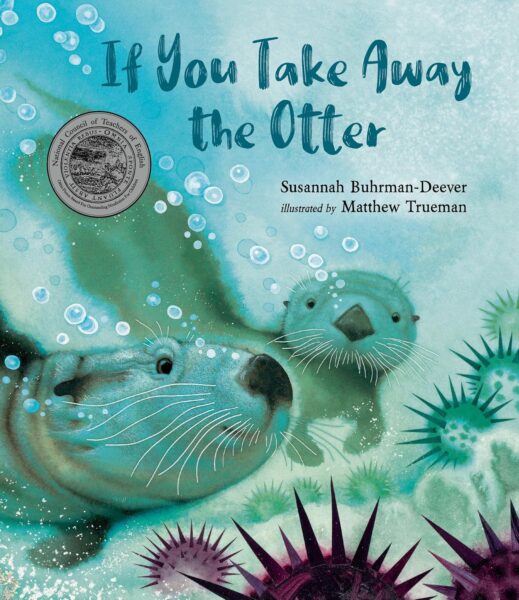
Sea otters are the smallest marine mammals, but they don’t have blubber like seals and whales. They have thick, soft fur made up of thousands of hairs packed together, which keeps the otters warm in the chilly waters. They also need a lot of food for energy to keep warm, and one of their prey is the sea urchin. These spiny creatures consume algae and kelp, and the otters keep them from ravaging the environment.
Long ago, Indigenous people lived alongside the otters, and nature was in balance. Unfortunately, other cultures found the otters and sought them out for their fur, hunting them almost to extinction. The sea otter is a keystone species, the organism that helps hold the system together. Once their numbers dwindled, the urchins took over, devastating the kelp and leaving many other animals homeless.
Luckily, good stewards joined together and signed a treaty to stop the hunting. This allowed the sea otters to reestablish themselves in the area and keep the urchins at bay. It wasn’t long before the forests of kelp returned with the other residents.
Writing and Genre
Susannah Buhrman-Deever is the author of Predator and Prey (2019) and Before the Seed: How Pollen Moves (2024). She captures nature and its details wonderfully in her writing.
As a PhD in animal behavior, Susannah weaves the intricate lives of various species and the environment into one story. She introduces the reader to the world beneath the waves of the Pacific coast, as if entering a forest. Her words touch on the individual plants and animals as we wind our way through the kelp. We learn how they survive together, and this journey leads us to the sea otter. They are all connected in nature.
This nonfiction children’s book is great for introducing kids to many STEM principles. They can learn about food webs and how animals depend on one another for survival. They can explore animals and their place in history. They can even learn about principles such as Chesterton’s Fence, which holds that changes should not be made to something until the reason for its existence is fully understood.
Susannah’s story has two types of text. The larger font will appeal to younger readers and tell the story. The smaller font is suited for experienced readers and covers additional facts about the environment or history. This dual-level text makes the book a fabulous addition to public and elementary libraries, as well as homeschooling collections.
Illustrations and Visual Style
Matthew Trueman is the illustrator of Hippos Are Huge!: Read and Wonder (2017), In the Past: From Trilobites to Dinosaurs to Mammoths in More Than 500 Million Years (Paws, Fins, Feathers, Claws) (2018), and Simon and the Bear: A Hanukkah Tale (2020), to name a few. His technique uses acrylic paint and collages made from real plant parts. He literally brings nature to life on the page.
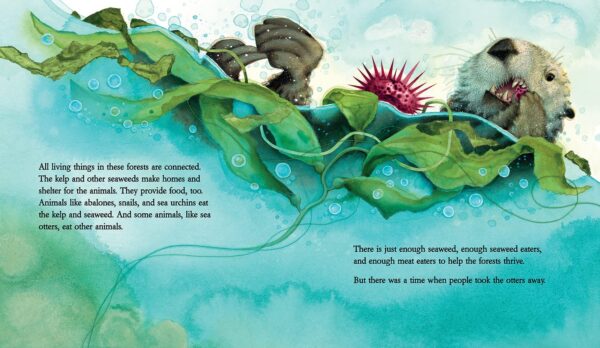
The balance of real and imagined material is refreshing. The soft aquatic colors set the book’s tone. The reader floats along the page and through the underwater world like a camera pans a movie scene.
I watched Matthew’s YouTube video on his acceptance speech for the 2021 Cook Prize, and he shows how he created his illustrations much like a movie storyboard. He took each sketch and taped it to a board to examine the flow of the drawings. Just like the animals in the book, he explains how the illustrations are all connected “as if they are one camera shot.”
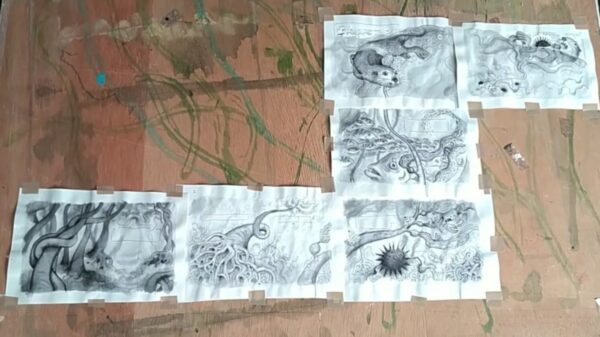
The blend of science and art appealed to me, and would be a great craft for children to explore. Children could responsibly collect natural artifacts and create their own art with them.
Written for ages 5–8, If You Take Away the Otter is a beautiful book that encourages children in grades K–3 to dive into STEM subjects with a dash of history. It is essential for elementary classrooms, homeschool libraries, and any family focusing on marine biology education, conservation for kids, or Indigenous ecological knowledge. You’re never too old to learn new things about our ever-changing natural environments.