

Fortune Cookie Friday: What Is the Purpose of Life?
Ever wonder what your life is really for? Today’s fortune says: “There is only one success—to be able to live your life in your own way.” This thought may help you find your purpose.
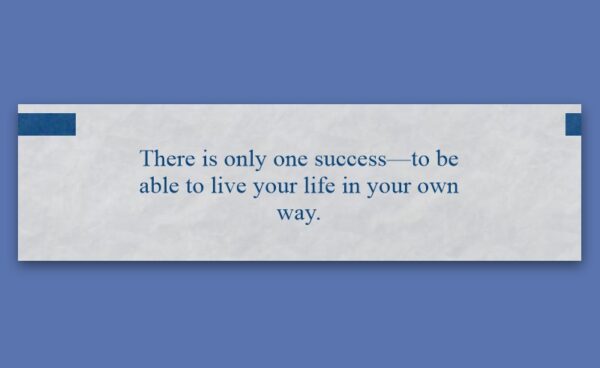
This line comes from Christopher Morley’s 1922 novel, Where the Blue Begins. It’s a whimsical, thoughtful story about Gissing, an anthropomorphic (human-like) dog who searches for meaning. “Doing everything our way” sounds awesome, but purpose is richer than self-indulgence. Morley suggests true success blends autonomy with love, service, and community.
A Brief Look at Where the Blue Begins

Gissing is a bachelor “gentledog” living comfortably in the suburbs. Still, he feels spiritual restlessness and longs for “where the blue begins.” That “blue” is a metaphor for purpose and an ideal life. His journey unfolds in clear phases:
- Surrogate fatherhood: He adopts three abandoned puppies. Caring for them brings him joy and a sense of duty, but he also realizes he needs more money to provide for them.
- Business: He leaves the puppies under the care of Mr. Spaniel and moves to the city. He gets a low-level job at a department store but quickly works his way up to general manager. The material success doesn’t satisfy his existential hunger.
- Religious inquiry: Seeking spiritual answers, He joins the clergy as a lay reader in a small country chapel. He lives among wealthy parishioners and enjoys comfort and companionship, including Miss Airedale. Yet he finds the organized religious institutions of his canine world equally unfulfilling. After an unauthorized sermon, he escapes the pack of snarling parishioners.
- Adventure and return: After farcical escapades, he stows away on an ocean liner, befriends the ship’s captain, briefly gains authority, and revels in the sea’s beauty. Chaos follows as the passengers lose patience. He escapes and eventually returns home to the puppies.
- Realization: The “heavenly blue” isn’t in far-off places or grand titles. It lives in love, service, and home.
The Fortune’s Meaning
Gissing considers this idea while unemployed in the city, thinking about time and wasted lives. “Living your life in your own way” means agency and integrity—choosing with intention, not selfishness. Autonomy matters, but so do responsibility and connection.
Autonomy vs. Responsibility
- Freedom is attractive, especially in youth, when we ache to act on our own.
- Life has real needs: shelter, food, and clothing. Those needs tie us to work, money, and routines.
- People are social creatures. We need a “pack” to thrive.
- Purpose grows where commitment, contribution, and belonging intersect.
A Zoologist’s Take on Purpose
As a zoologist, I see life or the meaning of life scientifically and believe that passing on information is part of our purpose. Every creature tries to pass on information.
Both animals and people reproduce to pass on genetic information. They also pass on behavioral information, such as hunting and foraging. For people, this might look like teaching your child to ride a bike, sharing your work experience with a colleague, or even passing along a family recipe. When we help others learn or grow, we are fulfilling the same purpose seen throughout nature.
Reflecting on this can inspire us to take small, intentional steps to support and teach those around us, knowing these everyday moments are a meaningful part of what it means to live well.
People took that to the next level, telling stories—both fiction and non-fiction—to pass on information they had learned from others along the way.
All of this requires a community of people who teach us, care for us, and love us. That’s what Gissing learns in the book: meaning lives in relationships and steady acts of care.

Find Your Blue
If you’re searching for your purpose—your own “where the blue begins”—start close to home. Think about ways you can share your wisdom, strength, and compassion with your “pack”. Success isn’t just doing whatever you want; it’s living true to your values while serving others. That’s a life lived in your own way—and one that matters.
This week, try one small act of service for someone nearby—family, friend, or team—and notice how it feels.