
Fortune Cookie Friday: Learn from the Past
January is behind us, and we are moving headlong into February. Punxsutawney Phil forecasted six more weeks of winter, but I don’t give much credence to his prognostication. The seasons are ever-changing and yet cyclical. Instead, I look to wisdom from other sources.
Take this month’s fortune cookie, for example.
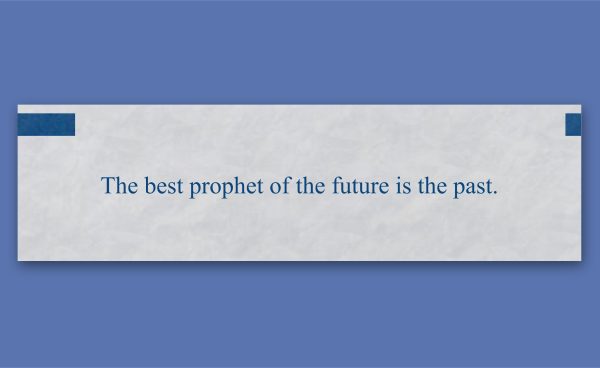
Attributed to Lord Byron, the saying “The best prophet of the future is the past” sounds like sage advice. It feels obvious, like the type of advice you nod to and go about your day. Yet it also resonates with one of the most poetic passages in the Bible: Ecclesiastes 3:1–8.
a time to be born and a time to die,
a time to plant and a time to uproot,
a time to kill and a time to heal,
a time to tear down and a time to build,
a time to weep and a time to laugh,
a time to mourn and a time to dance,
a time to scatter stones and a time to gather them,
a time to embrace and a time to refrain from embracing,
a time to search and a time to give up,
a time to keep and a time to throw away,
a time to tear and a time to mend,
a time to be silent and a time to speak,
a time to love and a time to hate,
a time for war and a time for peace.Ecclesiastes 3:1-8 (NIV)
The Bible identifies the author as “the Preacher” or “Teacher,” and is attributed to King Solomon, son of David. He lays out life not as a straight line racing toward some finish, but as a series of repeating rhythms. Seasons turn, emotions ebb and flow, relationships shift. Nothing is set in stone, yet nothing is truly new under the sun. These cycles keep occurring throughout our lives.
That’s why this fortune-cookie wisdom lands so perfectly. The past isn’t a dusty archive we leave behind—it’s the most honest forecaster we have. It shows us patterns in life: how heartbreak eventually softens into growth, how a teen’s late-night worries often mirror the ones we once carried ourselves, how the joy of a child’s first steps echoes the pride we felt at our own milestones long ago.

For parents reading this right now: Think back to your own teenage years. The arguments with your parents over curfews, the sting of a first breakup, the thrill of getting your driver’s license, or landing that part-time job. Those moments felt enormous, all-consuming. Now you watch your own kids navigate eerily similar storms. They have different apps, different slang, but the same core seasons of discovery, rejection, rebellion, and tentative triumph—the clothes change; the feelings don’t. Your past becomes the quiet compass, helping you respond with patience rather than frustration. You’ve walked these paths before, even if the scenery looks updated.
And for teens scrolling along: Your life might feel like uncharted territory—first crushes, college pressure, figuring out who you are amid the noise. But zoom out, and you’ll see your parents (and grandparents) were once exactly where you are, wrestling the same questions, making the same awkward stumbles. Their stories aren’t lectures; they’re proof that these seasons pass, that the tough parts build resilience, and that the good ones are worth savoring because they, too, won’t last forever.

My hubby and I recently helped our 24-year-old daughter move out of state for a new job. She was nervous about every decision: opening a bank account, finding her way around town, and living alone in her new apartment.
I remember when I first moved away from home. It was both scary and exciting. My family and friends helped me settle in, and it wasn’t long before I carved out a new home for myself.
We reassured our daughter with the knowledge we picked up over the years. Her angst lessened, and we felt proud of her accomplishments. But we also felt a bit of sadness as we watched our youngest move away. Luckily, we know the joy of a job well done in child rearing will replace the sadness.
The beauty of both Byron’s line and Ecclesiastes is the gentle reassurance buried inside: We’re not doomed to repeat mistakes. We can learn from them. The past whispers, “You’ve survived this kind of difficulty before—here’s what helped last time.” It reminds us that joy returns after sorrow, that effort after failure often bears fruit, and that letting go makes space for new beginnings.
In a world obsessed with predicting tomorrow through algorithms and trends, this old wisdom feels refreshingly humble. We don’t need a crystal ball, just honest reflection on what’s already happened. History, personal or collective, doesn’t dictate the future, but it illuminates a likely path.
So as this month unfolds, pause over your coffee (or between homework sessions) and ask: What season am I in right now? What echoes from my past—or my family’s past—might guide me through it? The answer might just be folded inside yesterday’s fortune cookie.